The purpose of this document is to provide an accurate overview of the available evidence in relation to the impacts of the requirements for renewable hydrogen set out in the Delegated act on Renewable Fuels of Non-Biological Origin (RFNBO DA). As such, this should be considered as a helpful resource in the ongoing discussions on the potential review of those requirements. Stakeholders across the spectrum agree that robust data and scientific evidence are a prerequisite for sound policymaking1.
Key findings:
- There is currently no robust evidence isolating RFNBO rules as the dominant bottleneck for renewable hydrogen development. Quantitative assessments suggest that the green premium associated with the requirements is below €1/kg of hydrogen. Beyond the price gap, feedback from more than 40 project developers indicates that policy uncertainty and limited offtake are considered equally significant barriers to market rollout.
- A narrow focus on cost per kilogram of hydrogen (€/kg of H2) as a primary cost metric may not capture broader energy system effects. Evidence from energy system modelling indicates that relaxing current requirements could increase grid electricity demand in peak hours, putting upward pressure on electricity prices.
- Available evidence indicates that additionality and temporal correlation remain important safeguards for ensuring renewable hydrogen delivers genuine emissions reductions and supports, rather than undermines, power sector decarbonisation.
Context
The Commission Delegated Regulation (EU) 2023/1184 on Renewable Fuels of Non-Biological Origin (RFNBO DA) establishes rules under which, irrespective of their origin, hydrogen, hydrogen-based fuels or other energy carriers, such as e-ammonia, are considered as RFNBO in the European Union. Following extensive stakeholder consultation, technical analysis and political scrutiny, the European Commission adopted the RFNBO Delegated Act in February 2023 and it entered into force in July 2023.
In May 2026, the Commission's Accelerate EU communication announced a targeted review of the RFNBO framework, two years ahead of its planned review in mid-2028. This review comes at a time of increasing pressure from some industrial and political stakeholders to revisit core provisions relating to additionality, temporal correlation and geographical correlation arguing that it would have a positive influence on price signals and increase European competitiveness.
The success of Europe's hydrogen strategy depends on aligning competitiveness, investment certainty and environmental integrity. Any assessment of the RFNBO framework should therefore be guided by three principles:
- The review should remain evidence-based. The Commission has already launched work to assess the effectiveness of the framework and identify barriers to renewable hydrogen deployment. Decisions on any future amendments should be informed by robust empirical evidence rather than assumptions about the causes of slower-than-expected market uptake.
- Regulatory certainty matters for investment. Hydrogen projects require significant upfront capital and long development timelines. Investors, project developers and partner countries all depend on predictable regulatory frameworks when making investment decisions. Prematurely reopening core rules risks creating uncertainty and undermining confidence in the EU's hydrogen market, as well as penalising early movers that have already planned projects and/or secured financing under the current rules.
- Any revision must preserve environmental integrity. The RFNBO rules were designed to ensure that renewable hydrogen delivers genuine emissions reductions and supports, rather than undermines, the decarbonisation of Europe's power system. Any proposed changes should therefore demonstrate that they can support market development without creating adverse climate, energy system or societal impacts.
A number of claims criticising the RFNBO framework have gained prominence in recent policy discussions. This document examines those claims against the available evidence to support an informed and evidence-based debate on the future of the RFNBO Delegated Act.
Overview of claims and available evidence
1.“Hydrogen is not happening under the current RFNBO rules – they are the main reason projects are not moving forward.”
What the evidence shows:
While RFNBO requirements can influence project design and economics, there is currently limited evidence that they are the primary constraint on renewable hydrogen deployment. The sector is instead shaped by a combination of structural and market-related barriers, many of which pre-date or operate independently of the RFNBO framework.
For example, the largest winner of the second EU Hydrogen Bank auction decided to withdraw its application because of delays in hydrogen pipeline development, which was meant to connect the electrolyser with offtakers, making the business case highly uncertain.2
Additionally, as highlighted in an ongoing Commission-supported study, project developers consistently point to a range of constraints of broadly similar importance, including long-term policy uncertainty at national, EU and international levels, difficulties in securing bankable offtake agreements, and the persistent cost gap between renewable hydrogen and fossil-based alternatives. These factors are compounded by high electricity prices, electrolyser capital costs, network tariffs, supply-side targets and/or subsidies, hydrogen infrastructure bottlenecks, permitting delays, and grid access constraints.
Implication:
There is currently no robust evidence isolating RFNBO requirements as the dominant bottleneck. Framing the rules as the primary barrier risks misdiagnosing a set of structural market and infrastructure challenges that require separate policy responses.
2.“RFNBO rules are killing first movers.”
What the evidence shows:
Despite challenging market conditions, early hydrogen projects are progressing under the existing RFNBO framework, including the structuring of long-term renewable supply agreements and offtake contracts that are explicitly aligned with current requirements.
Recent market data3 indicates continued build-out of electrolysis capacity in Europe, with 571 MW installed as of mid-2025 and approximately 2.84 GW under construction. The completion of the first 100 MW electrolyser in Portugal further demonstrates that large-scale projects are already reaching implementation under the existing regulatory framework.
In parallel, commercial activity continues to emerge across multiple Member States, including integrated renewable supply models and long-term industrial offtake agreements structured around RFNBO compliance.
These developments indicate that the framework is operational in practice, even if scale-up challenges remain.
Importantly, the Delegated Act already contains significant transitional flexibility. Installations entering operation before 2028 are exempt from additionality requirements until 2038, and monthly temporal correlation remains applicable until 2029. These provisions were explicitly designed to support early market development while the system matures.
Implication:
The existence of deployment challenges does not imply regulatory failure. Rather, early market activity demonstrates that RFNBO-compliant project structures are already feasible. Reopening core rules at this stage risks undermining investment certainty for first movers who have already committed under the current framework.
3. RFNBO rules will make renewable hydrogen prohibitively more expensive”
What the evidence shows:
Recent peer-reviewed, independent studies estimate that RFNBO requirements related to additionality, temporal correlation and geographical correlation increase hydrogen production costs by approximately €0.30–0.35 per kg of hydrogen at the system level4. This range is broadly consistent with support levels observed in recent EU Hydrogen Bank auctions for RFNBO and low-carbon topics, which fall between €0.57 and €0.98 per kg of RFNBO hydrogen. Importantly, cost impacts attributed to RFNBO requirements should be distinguished from the broader challenge that renewable hydrogen remains significantly more expensive than fossil-based alternatives. Even if RFNBO-related costs were reduced, the fundamental competitiveness challenge would remain largely unchanged.
The significance of these cost impacts should also be considered over different time horizons. In the near term, renewable hydrogen deployment volumes remain substantially below initial expectations, meaning that the system-wide impacts of maintaining existing safeguards are likely to be relatively limited. Over the longer term, however, as hydrogen demand and electricity consumption scale, the consequences of weakening additionality, temporal correlation and geographical correlation become more significant. At higher deployment volumes, diverting renewable electricity from other uses or increasing reliance on fossil-based marginal generation could have materially larger impacts on both power system costs and emissions.
Furthermore, the estimates must be interpreted in context. Electricity prices remain the dominant driver of hydrogen production costs (IEA). While long-term Power Purchase Agreements (PPAs) may increase the contracted cost of electricity compared with some merchant procurement strategies, direct exposure to volatile spot markets is generally incompatible with project finance requirements for capital-intensive hydrogen projects. A Eurelectric study from 2023 established significant hedging benefits of power procurement with high levels of hourly correlation (80%+) between renewables generation and demand, as the consumer is better protected from spot market volatility. This is likely even more the case at today’s technology costs numbers. Moreover, methodological differences across studies mean that cost impacts vary depending on assumptions regarding system design, flexibility, and regulatory interpretation.
More importantly, a narrow focus on €/kg hydrogen production costs does not capture system-level effects. RFNBO requirements are designed to ensure that hydrogen production does not rely on fossil-based marginal electricity, and to preserve the role of electrolysers as flexible demand that supports renewable integration. Indeed, by adjusting their operating hours to match periods of high renewable generation and low grid demand, electrolysers can absorb surplus wind and solar electricity, reduce curtailment, and avoid increasing fossil generation during peak demand periods. In this sense, the framework is intended not only to minimise production costs, but to avoid shifting costs and emissions onto the wider electricity system through higher power prices, increased network costs, additional fossil generation or slower progress in direct electrification.
Implication:
Even where RFNBO rules increase slightly direct hydrogen production costs, the available evidence shows that this increase is considerably lower than often claimed.5 The relevant policy question is whether cost reductions at plant level come at the expense of higher emissions or system inefficiencies elsewhere.
4.“The persisting high cost of new and unsubsidised Power Purchase Agreements (PPAs) makes RFNBO compliance unviable”
What the evidence shows:
Given the improving economics of renewables and batteries, portfolios with high levels of hourly matching are becoming increasingly competitive when compared to standard industrial retail tariffs in Europe, as shown in the analysis below from the IEA (Figure 1). By contrast, electrolysers operating inflexibly and with low levels of hourly matching will be exposed to high-priced power on spot markets and carbon-intensive hours, worsening both the economics of hydrogen producers and outcomes for the wider system. Therefore, it is critical that the RFNBO rules maintain a reality-based accounting approach.
The RFNBO rules do not require hydrogen producers to contract 100% of electricity consumption via PPAs. The rules allow RFNBO producers to claim exemption from 100% hourly PPA-electricity, when the electricity cost is below €20/MWh or less than 0.36 times the cost of an ETS carbon credit. Whilst this exemption is not yet used because electricity price is above this threshold according to respective National Energy and Climate Plans (NECPs), the share of electricity will fall below €20/MWh in Spain, Germany/Luxembourg, France, the Netherlands, and Belgium 50% or more of the time by 2030.
In addition, there is also no requirement for all hydrogen output to be claimed as RFNBO. Producers may combine RFNBO-compliant hydrogen with low-carbon electrolytic hydrogen, with only the RFNBO share subject to the relevant renewable electricity sourcing and temporal matching requirements. Where PPA-based renewable electricity is too costly or unavailable for all operating hours, the residual output may be produced using grid electricity and classified as low-carbon electrolytic hydrogen, provided the 70% lifecycle greenhouse gas emissions reduction threshold is met.
Figure 1: Total cost of electricity per unit consumed for hybrid options of wind, solar PV and battery in the United States, Europe and China
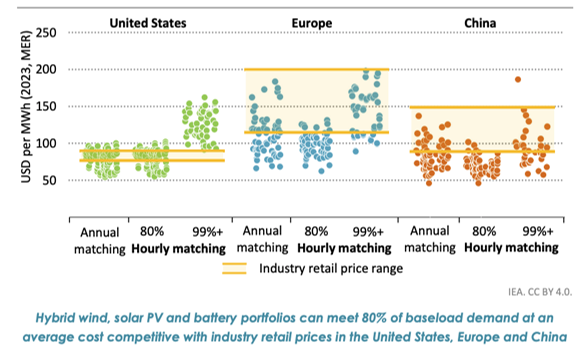
Analysis of matching requirements shows that the most cost-intensive component of compliance tends to be concentrated in the final approx. 10% of temporal and renewable matching obligations when price is the highest on the electricity stock market. At the same time, existing provisions allow for operational flexibility, including exemptions when electricity prices are low and renewable generation is high, supporting system-aligned operation.
Implication:
The RFNBO framework does not impose full reliance on 24/7 contracted renewable electricity; rather, it incentivises renewables in combination with storage and demand flexibility to ensure competitive, renewable hydrogen without sacrificing environmental integrity or risking significant price increases for all. Claims that it structurally prevents viable PPA-based hydrogen production are not consistent with the regulatory design or observed project structures.
5.“Europe’s grids are decarbonising anyway; therefore, additionality and temporal correlation requirements are no longer necessary"
What the evidence shows:
While EU electricity systems are steadily decarbonising, marginal electricity generation in many Member States still relies on fossil fuels during a significant number of hours. In this context, additional electricity demand from hydrogen production can lead to indirect emissions increases if it is not matched with new renewable generation and temporally aligned with renewable availability.
Without additionality and temporal correlation safeguards, hydrogen production risks displacing renewable electricity from other uses while increasing fossil generation elsewhere in the system. This “cannibalisation effect” has been identified in multiple system-level studies6, including Zeyen et al. (2024), which shows that emissions outcomes vary significantly depending on the degree of temporal matching applied.
For Germany in 2030, the absence of temporal matching can increase consequential emissions by approximately 10-30 kgCO₂ per kg of hydrogen compared to hourly matching, highlighting the material importance of temporal alignment for lifecycle emissions outcomes.
At the same time, emerging analysis of sector coupling, for example in the case of renewable hydrogen and e-fuels, suggests that flexible electrolysis can support system integration of renewable electricity when properly aligned with surplus generation. However, this system benefit depends on maintaining safeguards that ensure hydrogen production is genuinely additional and temporally correlated with renewable supply7.
The RFNBO rules already account for highly decarbonised grids: producers in bidding zones, where renewable sources exceed 90% of the electricity mix can be exempted both additionality and temporal correlation requirements. When the carbon intensity of the grid is below 18gCO2eq/MJ , producers can be exempted from additionality requirement. According to the Ember European Electricity Review 2025, at least eight countries will have a grid carbon intensity that will exempt them from the additionality requirement in 20308, with some of them from both requirements. This number is expected to increase by 2035. This rewards best-performing zones while maintaining safeguards where hydrogen demand could still drive an increase in fossil generation.
Implication:
Grid decarbonisation alone does not eliminate the need for RFNBO safeguards. The key policy question is not whether grids are cleaner over time, but whether additional electricity demand is met by additional renewable supply in a way that avoids shifting emissions within the system.
6. Hourly matching is an obstacle to scaling renewable hydrogen”
What the evidence shows:
Much of the debate around hourly matching focuses on its impact on hydrogen production costs and electrolyser utilisation. However, the primary purpose of temporal correlation is to ensure that renewable hydrogen delivers genuine emissions reductions at system level.
The current RFNBO framework already includes a gradual transition designed to reflect market and system readiness. Monthly temporal correlation applies until the end of 2029, with hourly correlation only becoming mandatory from 2030. Current electrolysers technologies, such as alkaline and PEM, typically require 5-15 minutes to reach operating conditions from a cold start, and this duration could be reduced to below 5 minutes with a warm start. Empirical evidence on the potential impacts in terms of stack degradation remains limited.
The debate should not be framed solely in terms of production economics but take into account the lifecycle emissions outcomes. Studies such as Zeyen et al. (2024) show that weaker temporal matching can significantly increase consequential emissions, with differences of up to 10-30 kgCO₂ per kg of hydrogen in some system contexts.
The distinction between monthly and hourly matching is therefore not merely technical. Under monthly accounting, hydrogen production can be decoupled from periods of renewable generation, allowing electricity consumption during higher-emission hours while still maintaining compliance at a monthly level. Hourly matching preserves a closer temporal link between renewable generation and hydrogen production while still allowing participation in electricity markets through separate trading of renewable electricity.
Illustrative example: Why monthly and hourly matching are not equivalent
Arguments in favour of retaining monthly matching are sometimes presented as enabling more "grid-friendly" operation of electrolysers. However, this can conflate flexibility in electricity markets with RFNBO-compliant hydrogen production.
Under monthly matching, an electrolyser operator has a strong incentive to maximise utilisation rates in order to spread high capital costs over as many operating hours as possible. This allows the operator to purchase electricity from the grid during hours when its contracted renewable installation is not generating electricity, while still claiming RFNBO compliance provided that the monthly accounting balance is met.
In practice, this weakens the temporal link between renewable electricity generation and hydrogen production. The electrolyser can operate more like a large baseload electricity consumer, drawing power during periods when additional renewable generation is unavailable and the electricity mix may be more carbon intensive. This also has price implications: electrolysers running on grid electricity during high-demand, carbon-intensive hours will further aggravate already elevated electricity prices, and operators exposed to such hours may require growing levels of subsidy support.
Under hourly matching, the situation is different. Renewable electricity generated under a power purchase agreement (PPA) can still be sold to the grid during periods of high prices, supporting efficient system operation. However, the hydrogen producer can only claim RFNBO-compliant hydrogen production when renewable generation is available in the same hour (or another compliant renewable source is available). This preserves the link between renewable generation and hydrogen production while still allowing participation in electricity markets.
The distinction is important because monthly matching can allow renewable electricity exported to the grid during some periods to be used to justify hydrogen production during entirely different periods, including hours when additional electricity demand may increase fossil generation elsewhere in the system. Hourly matching is intended to reduce this risk and ensure that renewable hydrogen delivers the emissions reductions it is designed to achieve.
Implication:
Any proposal to weaken or postpone hourly matching must demonstrate not only improved deployment outcomes, but also equivalent system-level emissions performance. In the absence of such evidence, the rationale for weakening temporal correlation is very weak. Available evidence suggests this could increase system-level emissions and place upward pressure on electricity prices for all, as the critical incentive needed for flexible electrolysers is removed.
Conclusion
The debate around RFNBO rules should not be framed as a choice between competitiveness and environmental credibility, and perceived deployment bottlenecks should not be automatically interpreted as regulatory design failures.
Europe needs a hydrogen framework that is: investable, stable, evidence-based, and capable of delivering genuine emissions reductions.
Any future revision of the RFNBO framework should therefore follow robust empirical evidence and preserve the environmental integrity and legal certainty on which long-term market confidence depends. Proposals to weaken core safeguards should demonstrate not only that they improve deployment outcomes, but that they also do not create adverse climate, energy system or societal impacts.
Organisations:
References:
1 See the Antwerp Declaration (https://antwerp-declaration.eu/) and recent letter by civil society organisations and e-fuel producers calling for an evidence-based review of the RFNBO DA (https://library.edf.org/AssetLink/151143b5erso271k44nh8r044s3x3am4.pdf)
2 https://fuelcellsworks.com/2025/08/12/energy-policy/largest-european-hy…;
3 Clean Hydrogen Monitor 2025
4 Hordvei et al. (2025) and EWI (2025)
5 Hydrogen Europe, 2026, current barriers and enables for clean hydrogen. https://circabc.europa.eu/ui/group/49f99d46-494e-454b-a214-f7037bd7b762/library/a07a5f8a-ecd1-49a4-822f-5ab0298d3d16/details
6 de Kleijne et al. (2024); Ricks et al. (2023), Giovanniello et al. (2024), Besseau et al. (2026)
8Ember (2025) European Electricity review